

 en
 ru
 sa
 es


Nov, 12, 2026
Automotive Film Guide 2026: Window Tint, PPF and Color Change Film
Content
- 1 The Short Answer: Which Automotive Film Should You Choose
- 2 What Automotive Film Is and the Three Main Categories
- 3 Automotive Window Film Types Compared: Dyed, Carbon, Ceramic and Hybrid
- 4 How Automotive Window Film Controls Heat, Glare and UV Light
- 5 Choosing the Right Shade for Each Window
- 6 Paint Protection Film: What It Does and How Long It Lasts
- 7 Color Change Film, Color PPF and Vinyl Wrap: Key Differences
- 8 What to Look for in an Automotive Film Manufacturer
- 9 Matching Automotive Film to Your Climate and Driving Pattern
- 10 How Automotive Film Is Installed, Step by Step
- 11 What Drives the Price of Automotive Film Jobs
- 12 Aftercare: Keeping Film Clear and Intact
- 13 Common Mistakes When Buying Automotive Film
- 14 Automotive Film Trends in 2026
- 15 A Short Look at How Established Film Brands Built Their Reputation
- 16 Automotive Film FAQ
- 16.1 What is automotive film used for?
- 16.2 Is ceramic window film worth the extra cost?
- 16.3 How long does paint protection film last?
- 16.4 Can automotive film damage my paint or glass?
- 16.5 What is the difference between color PPF and vinyl wrap?
- 16.6 How long should I wait before washing the car after installation?
- 16.7 Does window film affect night visibility?
- 16.8 Can I install automotive film myself?
- 16.9 Can I combine window film, PPF and color change film on one car?
- 16.10 How do I choose between dyed, carbon and ceramic window film?
The Short Answer: Which Automotive Film Should You Choose
Most drivers get the best return from a ceramic window film on the side and rear glass for heat and UV control, and a clear self-healing paint protection film (PPF) on high-impact panels such as the hood, front bumper, mirrors and door edges. Drivers who want a new color without repainting should look at color change film or color PPF, depending on how much stone-chip protection they also want.
Automotive film is not one product. It is a family of thin polymer laminates that each solve a different problem: window film manages sunlight and privacy, PPF absorbs road damage, and color change film alters appearance. Picking the wrong category is the most common reason a film project disappoints, so the rest of this guide explains how each type works, how they compare and how to match them to your car, climate and budget.
- Heat and glare problem: choose ceramic or high-grade carbon window film.
- Chips, scratches and swirl marks: choose clear TPU paint protection film.
- New look with minimal commitment: choose color change film.
- New look plus serious protection: choose color PPF.
What Automotive Film Is and the Three Main Categories
Automotive film is a multi-layer laminate applied to glass or painted surfaces to change how the vehicle handles light, heat, impact or appearance. Industry research groups usually split the market into window films, wrap films and paint protection films, and they also separate interior applications from exterior ones. That split mirrors how installers actually work: glass jobs happen inside the cabin, while paint jobs happen on the outer body.
Automotive window film
Applied to the inside of the glass, window film cuts solar heat, blocks ultraviolet light, reduces glare and adds privacy. Even entry-level films typically hold the glass together better if it shatters, and most reach about 99 percent UV blocking, according to Filmtack. Premium films add stronger heat reduction, which is where ceramic technology comes in.
Paint protection film
PPF is a clear thermoplastic polyurethane (TPU) layer with a self-healing top coat. It is applied to the exterior paint and absorbs gravel strikes, bug acids, bird droppings and light scratches so the clear coat underneath stays intact.
Color change film
Also called a vinyl wrap, this film changes the visible color or finish of the body, from gloss and satin to matte and metallic. It is thinner and cheaper than PPF, and it can be removed when the owner wants the original look back.
Automotive Window Film Types Compared: Dyed, Carbon, Ceramic and Hybrid
Window film performance depends mostly on what absorbs or reflects the energy. The table below summarizes how the four common constructions differ in everyday use.
| Film Type | Heat Control | Color Stability | Signal Impact | Best For |
|---|---|---|---|---|
| Dyed | Basic | Fades sooner | None | Privacy on a tight budget |
| Carbon | Good | Stable matte look | Rare issues | Daily drivers wanting a dark, flat tone |
| Ceramic | Excellent | Very stable | None | Hot climates, EVs, long commutes |
| Hybrid | Good to very good | Stable | Low | Balanced cost and performance |
Why dyed film falls behind
Dyed film relies on pigment in the layers to absorb light. Flex Film notes that dyed products offer less UV and heat reduction than advanced films and lose effectiveness faster. That is why many installers treat dyed film as a short-term, appearance-first option.
Carbon and the signal question
Carbon film uses carbon particles to block infrared energy, giving better heat insulation than dyed film. The same source points out that some carbon films can interfere with phone and GPS reception, although this is uncommon with well-made products. Ceramic film avoids the question entirely because its nano-ceramic particles are non-metallic and non-conductive.

Ginnva Automotive Window Film
A window film range built around heat control and clarity for new energy vehicles and conventional cars alike. View the window film range
How Automotive Window Film Controls Heat, Glare and UV Light
Sunlight reaches a cabin as three bands: ultraviolet, visible and infrared. Each band causes a different problem, and a good film treats them separately.
- Ultraviolet light fades dashboards, leather and door cards, and contributes to skin exposure on long drives. Quality films block nearly all of it.
- Visible light creates glare and eye strain. The film's visible light transmission (VLT) number tells you how much passes through.
- Infrared energy is what you feel as heat on your arms and legs. Ceramic and carbon layers target this band specifically.
Why a lighter film can outperform a darker one
Darkness and heat rejection are separate properties. A high-quality ceramic film at a light shade can reject more infrared energy than a cheap dyed film at a dark shade, because the ceramic particles do the work rather than the color. For electric vehicles with large glass roofs, this distinction matters even more, since the cabin has more glass area to defend and the air conditioner draws directly from the battery.
Practical effects you will notice
- Seats and steering wheel stay cooler after the car sits in the sun.
- The air conditioner reaches the target temperature faster and cycles less.
- Low-angle sun and oncoming headlights feel less harsh at night and at dawn.
- Interior plastics and fabrics keep their color for longer.
Choosing the Right Shade for Each Window
Shade selection is a balance between privacy, heat and night visibility. Most installers recommend choosing a lighter film for the glass the driver relies on and a darker film for passenger areas. Check the rules that apply where you drive before you finalize any number.
| Window Position | Typical Approach | Reason |
|---|---|---|
| Windshield | Very light or near-clear ceramic | Keeps forward vision sharp while cutting infrared |
| Front side windows | Light to medium | Preserves mirror visibility at night |
| Rear side windows | Medium to dark | Adds privacy and shades rear passengers |
| Rear window | Medium to dark | Reduces glare from following headlights and protects cargo |
| Sunroof or glass roof | High infrared rejection | Overhead glass is the largest source of heat gain |
Paint Protection Film: What It Does and How Long It Lasts
Paint protection film is usually a TPU film around 8 mil thick (roughly 0.2 mm). A guide from Gilroy Blackout places clear PPF durability at about 10 years and color PPF at 7 to 10 years, compared with 4 to 7 years for vinyl wrap. The self-healing top coat is the feature owners notice first: light scratches and swirl marks disappear when the film is warmed by sunlight or warm water.
Where PPF earns its cost
- Front bumper, hood leading edge and fenders, which take most gravel hits.
- Side mirrors and A-pillars, which see constant wind-blown debris.
- Door edges, door cup areas and trunk sills, where keys, bags and fingernails leave marks.
- Rocker panels and rear bumper tops, which suffer from spray and loading scuffs.
Coverage levels
Installers generally offer three tiers. A partial front covers the bumper, part of the hood and fenders, and mirrors. A full front adds the whole hood, full fenders and headlights. Full body coverage wraps every painted panel. Daily commuters on highways often stop at full front, while owners of new or high-value cars frequently choose full body.

Ginnva Paint Protection Film (PPF)
Built with the brand's in-house adhesive and precision coating technology for clean installation and long-term clarity. View the PPF range
Color Change Film, Color PPF and Vinyl Wrap: Key Differences
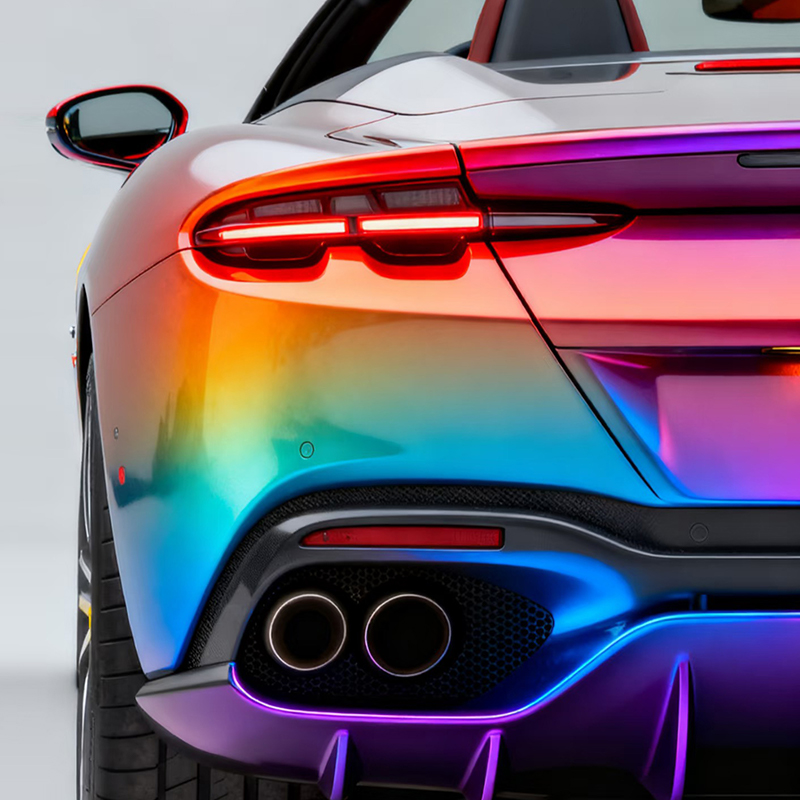
Color PPF has become one of the fastest-growing segments in vehicle protection, with satin black and matte military green among the most requested finishes going into 2026, based on the Gilroy Blackout guide. Energy Products Distribution adds that not every color PPF is equal: some are thinner and more decorative, while others use the same urethane base as the brand's clear film, giving a total thickness near 8 mil.
| Feature | Clear PPF | Color PPF | Vinyl Wrap |
|---|---|---|---|
| Impact protection | Excellent | Excellent | Minimal |
| Self-healing | Yes | Yes | No |
| Changes color | No | Yes | Yes |
| Thickness | About 8 mil | About 8 mil | 3 to 4 mil |
| Typical lifespan | About 10 years | 7 to 10 years | 4 to 7 years |
| Relative cost | High | Highest | Moderate |
When a vinyl color change film makes more sense
Vinyl is the better fit for leased vehicles, short ownership periods, temporary promotional looks, and owners who like to switch colors every few years. It costs less up front and removes cleanly when installed on sound factory paint.

Ginnva Color Change Film (CCF)
A color change range for owners who want a new finish with a smooth, controlled application. View the color change film range
What to Look for in an Automotive Film Manufacturer
Film quality starts at the coating line. Adhesive chemistry, coating precision and raw material control determine whether a film installs cleanly, stays clear and peels off without residue years later. When comparing suppliers, look at their research depth and production capacity rather than marketing claims alone.
Ginnva, a Shanghai-based functional film brand, lists more than 100 patents, over 260 R&D personnel, 3 R&D centers and 4 production bases on its official English site, with more than 20 service outlets supporting its window film, PPF, color change film and architectural film lines. Its stated core technologies include flexible sensing, self-developed adhesive, precision coating and degradable tape technology.
- Ask how the adhesive behaves during repositioning and final cure.
- Request spec sheets that list VLT, infrared rejection and UV blocking for each shade.
- Check whether the supplier offers cut data for your vehicle models.
- Confirm sample availability so your installers can test before committing to a roll order.
Matching Automotive Film to Your Climate and Driving Pattern
The same film performs differently in a desert city than in a rainy coastal town. Use the table to narrow your choice before talking to an installer.
| Situation | Primary Film | Optional Add-On |
|---|---|---|
| Hot, sunny region | Ceramic window film | Clear PPF on the hood and roof edge |
| Long highway commute | Full front PPF | Light ceramic window film |
| City parking and tight spaces | PPF on door edges and bumpers | Hybrid window film |
| Electric vehicle with glass roof | High infrared rejection ceramic film | Clear PPF on the front end |
| Style-focused owner | Color change film or color PPF | Ceramic window film for comfort |
| Leased vehicle | Removable vinyl or window film | Partial front PPF |
How Automotive Film Is Installed, Step by Step
Installation quality decides how a film looks on day one and year five. Professional shops follow a consistent sequence, and understanding it helps you judge a quote.
- Surface preparation. The glass or paint is washed, decontaminated and inspected. Any chip or dust left behind will show through the film.
- Pattern cutting. Most shops use a plotter with vehicle-specific data. For glass, some installers hand-cut film on the outside of the window before shrinking it to shape.
- Heat shrinking and fitting. Curved glass such as rear windows needs controlled heat to make the film lie flat without fingers or creases.
- Application with slip solution. The film is positioned on a wet surface, then squeegeed to push out water and air.
- Edge finishing. Edges are tucked or wrapped, and any stray moisture is cleared.
- Curing. Small water pockets or a slight haze can remain for several days to a few weeks while the film dries completely, depending on weather.
Why bulk installation from the roll carries risk
Wikipedia's overview of paint protection film notes that cutting film directly on the vehicle, without a plotter, risks cutting into paint. Pre-cut patterns avoid the blade touching the car at all, which is why they are the standard for premium PPF work.
What Drives the Price of Automotive Film Jobs
Quotes vary widely because several factors stack together. Instead of comparing a single total, compare what is included.
Film grade
Ceramic costs more than dyed because the particle coating is more complex. TPU PPF costs more than PVC alternatives because the polymer and top coat are more advanced.
Vehicle size and glass complexity
SUVs, vans and cars with large curved rear glass need more film and more labor. Panoramic roofs add another large piece.
Coverage and prep time
A full-body PPF job involves removing trim, wrapping edges and paint correction beforehand. Each step adds hours.
Installer skill and shop environment
A clean, enclosed bay with good lighting and a trained team costs more to run, and the result shows in edge quality and dust control.
Aftercare: Keeping Film Clear and Intact
Good aftercare costs little and extends film life noticeably. The routines differ slightly between glass film and paint film.
Window film care
- Leave the windows up for about three days after installation so the adhesive can settle.
- Clean with a soft microfiber cloth and an ammonia-free glass cleaner.
- Avoid razor blades, abrasive pads and sticky suction mounts on the film surface.
PPF and color film care
- Wait about a week before the first wash, and avoid high-pressure water at the film edges.
- Use a pH-neutral shampoo and a soft wash mitt.
- Remove bird droppings and bug residue quickly, since acids sit on the surface longer than you might expect.
- Use a film-safe sealant or ceramic topper if you want easier washing and more gloss.
Common Mistakes When Buying Automotive Film
- Choosing by darkness alone. Heat rejection comes from the film technology, not the shade number.
- Treating all color PPF as equal. Thin decorative films do not protect like a true 8 mil urethane product.
- Skipping paint prep. Film applied over chips, rust or failing clear coat can lift and pull paint on removal.
- Picking the lowest quote without asking what is included. Edge wrapping, trim removal and film brand all change the price.
- Washing too early. Cleaning a fresh install before the adhesive cures can lift edges.
Automotive Film Trends in 2026
Three shifts are shaping what shops stock and what owners ask for this year.
Color PPF moves into the mainstream
Owners increasingly want a single film that changes color and protects paint, and color PPF is now described by installers as the fastest-growing protection product of 2026. Satin and matte shades lead requests.
Electric vehicles raise the bar for infrared rejection
Large glass surfaces and the link between cabin cooling and driving range make high-performance ceramic film more attractive on EVs. Brands now position window film lines specifically for new energy vehicles.
Market breadth keeps expanding
Research publishers such as Research and Markets now track automotive window films, wrap films and paint protection films as separate segments across interior and exterior uses, which reflects how distinct each category has become.
A Short Look at How Established Film Brands Built Their Reputation
Window film is a mature technology. 3M states it has more than 55 years of automotive window tint innovation and received its first sun control window film patent in 1966. Avery Dennison describes its automotive window film business as built on over 35 years of innovation. Newer manufacturers compete by pairing that long development history with modern coating lines, nano-ceramic particles and application-friendly adhesives, which is why range depth and sample support matter when you compare brands.
Automotive Film FAQ
What is automotive film used for?
Automotive film covers three main uses: window film for heat, glare, UV and privacy, paint protection film for chips and scratches, and color change film for appearance. Many owners combine two or three.
Is ceramic window film worth the extra cost?
For hot climates, long drives and electric vehicles, yes. Ceramic film rejects more infrared heat at lighter shades, keeps its color over time and has no effect on phone or GPS signals.
How long does paint protection film last?
Clear PPF is generally cited at around 10 years, and color PPF at 7 to 10 years, as noted in the Gilroy Blackout guide. Actual life depends on climate, washing habits and film quality.
Can automotive film damage my paint or glass?
Quality film installed on sound paint and clean glass should not cause damage. Problems usually come from poor prep, low-grade adhesive or applying film over damaged clear coat.
What is the difference between color PPF and vinyl wrap?
Color PPF is a thick urethane film that changes color and protects paint with self-healing properties. Vinyl wrap is thinner, cheaper and mainly cosmetic, with a shorter typical life.
How long should I wait before washing the car after installation?
A common recommendation is about a week for PPF and color film, and about three days before rolling down freshly filmed windows. Your installer will give the exact timing for the product used.
Does window film affect night visibility?
Darker shades reduce the light reaching your eyes, which can make parking and side mirror use harder at night. Choosing lighter films for the front glass and darker ones for the rear is the usual solution.
Can I install automotive film myself?
Small flat pieces are possible for a patient beginner, but curved glass and full PPF coverage need heat shrinking, precise cutting and a dust-free space. Professional installation usually gives a cleaner result.
Can I combine window film, PPF and color change film on one car?
Yes. They work on different surfaces. A common package is ceramic window film for comfort, clear PPF on the front end for protection and a color film on selected body panels.
How do I choose between dyed, carbon and ceramic window film?
Choose dyed for a tight budget and basic privacy, carbon for good heat control at moderate cost, and ceramic for the best heat rejection, color stability and signal compatibility.

We provide customers with sustainable and eco-friendly adhesives, Automotive Film, customized material solutions and comprehensive technical services.
 Download
Choose Ginnva Auto Film for the perfect blend of performance and aesthetics.

- ADD: 17Floor, Buillding 8,G60 Ke Chuang corridor,No288, Qian Fan Road, XinQiao Town,Songjiang District, Shanghai, China
- Whatsapp: 8618041123913
- Email: info@ginnvafilm.cn
Copyright © Ginnva Auto Film Rights Reserved. China vehicle protective film factory custom automotive film manufacturer
